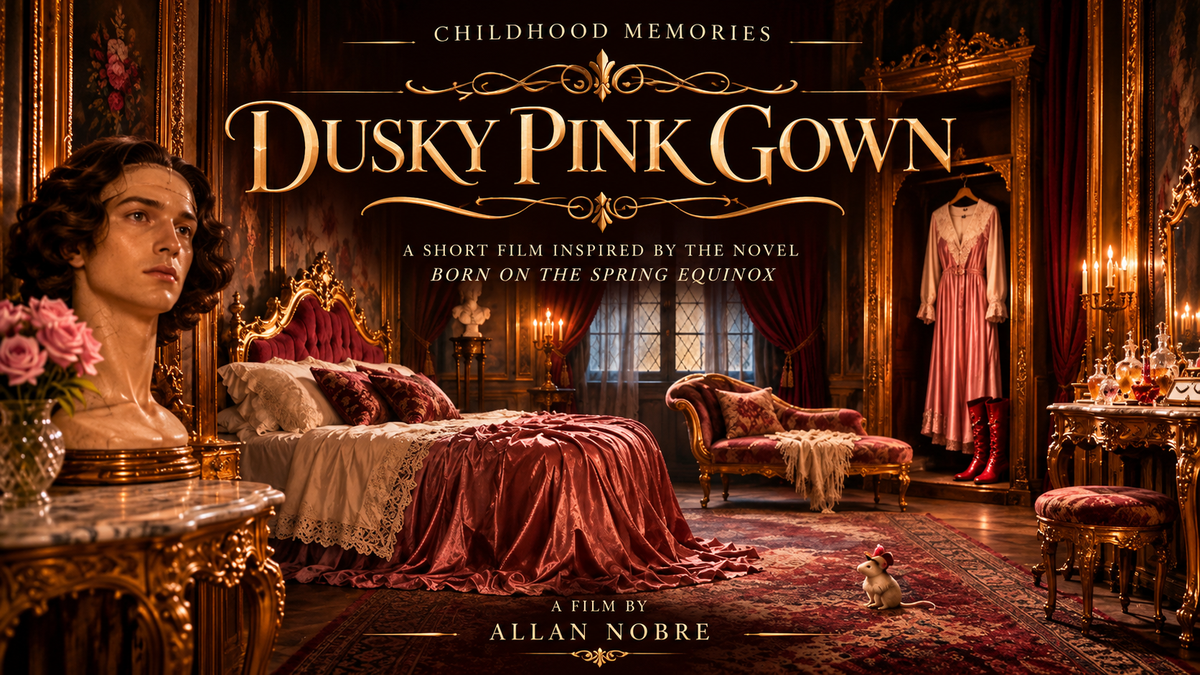
A bedroom filled with velvet, candlelight and the quiet splendour of another century. A pink satin gown hangs inside an ornate wardrobe. Nearby, a little mouse watches, while a sculptural figure seems to contemplate the room from another time. Everything appears still, yet something is about to happen.
Dusky Pink Gown returns to the childhood world of Angelo, the protagonist of my novel Born on the Spring Equinox. Through the language of surrealist cinema, the film explores an intimate moment in which curiosity, beauty and imagination begin to reveal something about the child’s emerging identity.
The gown is more than a beautiful garment. It becomes an invitation to enter another world, one where the boundaries between childhood play, dreams and the unconscious begin to dissolve.
THE UNCONSCIOUS THEATRE
The setting of Dusky Pink Gown is deliberately theatrical. Heavy curtains, gilded furniture, mirrors, elaborate fabrics and candlelit interiors create an atmosphere somewhere between a Baroque painting and a dream.
I have always been fascinated by rooms that appear to preserve the emotional lives of those who once inhabited them. A bedroom, particularly in childhood, can become much more than a place to sleep. It can be a private theatre where imaginary stories unfold, where ordinary objects acquire extraordinary meanings, and where a child begins to discover the possibilities of being someone else.
In this film, the bedroom functions almost as a representation of the unconscious. The chaise longue recalls the furniture associated with psychoanalysis, particularly the couch upon which patients were invited to speak freely about memories, dreams and desires. Yet Angelo does not need to explain himself. His imagination speaks through images. The room becomes a landscape of feelings that have not yet found their way into words.
THE PINK GOWN: BEAUTY, CURIOSITY AND DESIRE
At the centre of the film is a pink satin gown. For an adult, it might be understood simply as an item of clothing, associated with femininity, elegance or theatrical performance. For a child, however, its meaning can be far more expansive. The softness of the fabric, the movement of satin, the delicate colour and the possibility of transformation can awaken a fascination that exists before any conscious understanding of social expectations. Angelo is drawn towards the gown because it is beautiful, mysterious and full of imaginative possibilities. I wanted to preserve the innocence of that attraction.
Children do not necessarily experience beauty according to the categories that adults have learned to recognise. A garment may become a costume, a character, a dream or an entirely new version of the self. The gown therefore represents something both simple and profound: the freedom to explore beauty without having to justify one’s fascination with it.
THE CHILD AND HIS FUTURE SELF
One of the most intriguing elements of the film is the presence of the sculptural adult figure. Its stillness contrasts with the curiosity and movement of childhood. I imagine this figure as a possible representation of Angelo’s future self, observing a memory that continues to exist somewhere within him.
There is something deeply moving about the idea that the adult we become might one day look back at the child we once were. Would we recognise that child’s desires? Would we understand the significance of the objects that fascinated us? Would we remember the freedom with which we once imagined ourselves?
The figure does not intervene.It watches. Its presence suggests that childhood is never entirely lost. Certain images, sensations and emotional experiences remain with us, even when their original meanings become difficult to recover. In this sense, the film is not simply about a child discovering a gown. It is also about an adult returning to an early moment of self-discovery.
THE LITTLE MOUSE AND THE LANGUAGE OF DREAMS
The little mouse introduces another layer of symbolism. Small, curious and almost inconspicuous within the magnificent bedroom, it appears to belong to the secret life of the room.
While the mouse directs its attention towards the gown, Angelo’s imagination reaches beyond the object itself. This contrast interests me. One creature observes something tangible; the other begins to imagine what that object might become.
The mouse also brings an element of fairy-tale storytelling into the film. It reminds us of those childhood narratives in which animals become witnesses, companions or silent participants in extraordinary events. Its presence is deliberately open to interpretation. Like many objects and figures in dreams, it does not need a single explanation to acquire emotional significance.
MEMORY, PSYCHOANALYSIS AND THE UNFINISHED SELF
Psychoanalysis has long influenced the way I approach literature and visual art. I am particularly interested in the idea that childhood experiences may continue to shape our emotional lives long after the events themselves have disappeared from conscious memory.
Freud’s exploration of dreams and the unconscious offers one way of considering the relationship between remembered experiences and hidden desires. Jung’s writings on symbols and the development of the self suggest another possibility: that images appearing in dreams and fantasies may express aspects of our psychological lives that we do not yet fully understand.
I do not intend Dusky Pink Gown to illustrate a particular psychoanalytic theory. Instead, I borrow from the atmosphere of psychoanalysis: its attention to memory, symbolism, desire and the strange persistence of childhood experiences. The gown, the mirror, the bedroom and the observing figure form a visual language through which Angelo’s inner world can be explored.
The film also touches upon a question that has accompanied much of my creative work: how much of our childhood remains present in the adults we become? Perhaps identity is never entirely finished. It continues to emerge through the memories we revisit and the meanings we discover within them.
THE FREEDOM TO BECOME
There is also a quiet social dimension to the story. Children are often introduced to expectations about which colours, clothes, toys and behaviours are considered appropriate for them. These expectations can arrive long before a child has developed the language to question them. Angelo’s fascination with the pink gown belongs to a moment before such distinctions need to be explained. He is not making a declaration or attempting to challenge the world around him. He is simply curious. I find something beautiful in that simplicity.
The film invites us to consider how easily adults can impose meanings upon experiences that, for a child, may begin with nothing more complicated than wonder. To allow a child to explore beauty, imagination and self-expression is also to recognise the importance of an inner life that belongs to them.
RETURNING TO ANGELO’S WORLD
Dusky Pink Gown belongs to my continuing exploration of the childhood memories and imaginative landscapes surrounding Born on the Spring Equinox.
Alongside films such as Granny Sofia and The Doll’s House, it approaches Angelo’s early life through the visual language of memory, fantasy and theatrical storytelling. Each film opens another small passage into his universe.
Where The Doll’s House celebrates the creative freedom of childhood play, Dusky Pink Gown moves towards a more private experience: the discovery that an ordinary object can awaken feelings and possibilities that a child cannot yet name.
I wanted the film to preserve that delicate moment without explaining away its mystery. The pink gown hangs quietly in the bedroom, waiting to be discovered. And somewhere between the child who reaches towards it and the adult who remembers, a story about identity begins to unfold.
Perhaps the most extraordinary transformations begin not when we become someone else, but when we discover something that has always belonged to us.
DUSKY PINK GOWN
A surrealist short film inspired by Born on the Spring Equinox, exploring childhood curiosity, identity and the unconscious through the mysterious beauty of a pink satin gown.
Explore the novel Born on the Spring Equinox to discover more of Angelo’s world.
More from the Journal
Cinema & Short Films
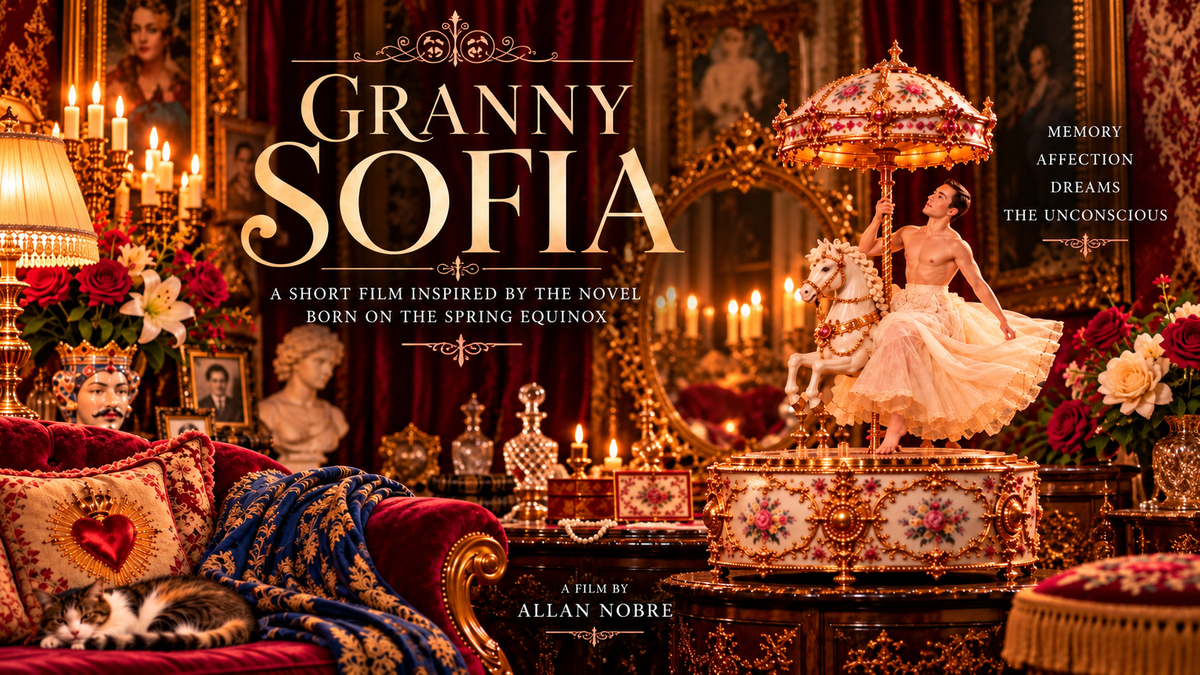
GRANNY SOPHIA
An original surrealist short film inspired by Born on the Spring Equinox, a novel by Allan Nobre.
Cinema & Short Films
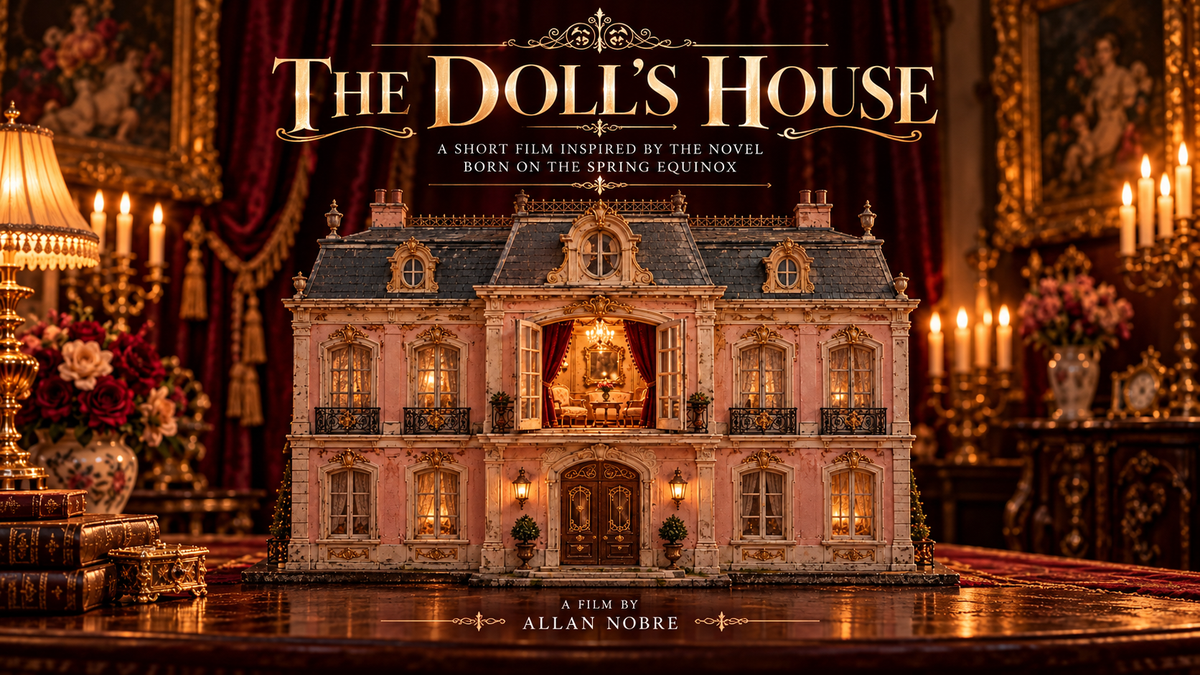
THE DOLL’S HOUSE
A short film inspired by Born on the Spring Equinox, on childhood, imagination and the quiet freedom to play.
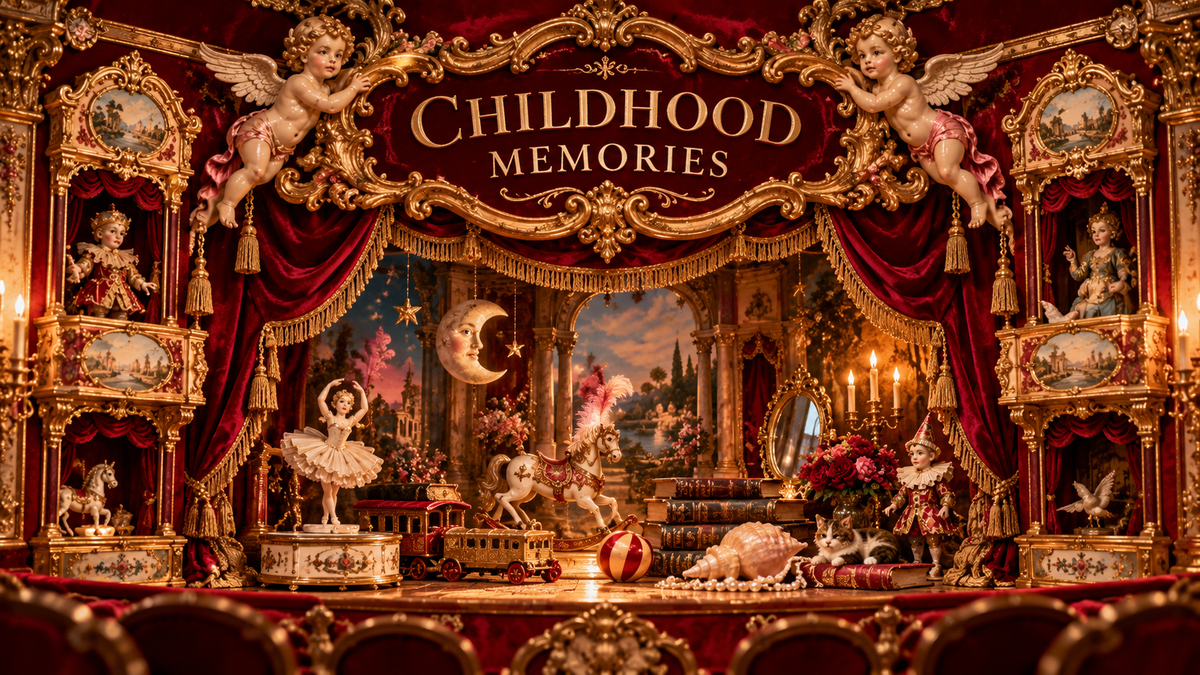
CHILDHOOD MEMORIES
A collection of surrealist short films inspired by Born on the Spring Equinox, exploring childhood, memory, imagination and the unconscious.