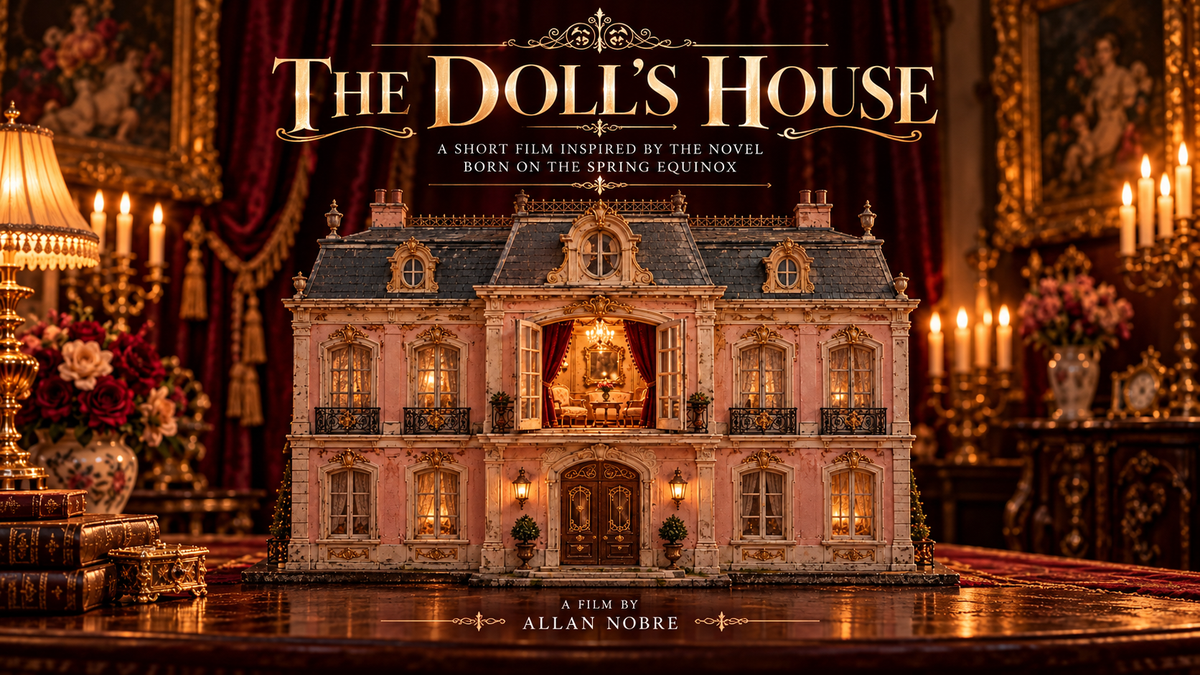
A miniature house stands in a room filled with shadows and candlelight. Its windows glow warmly; behind them lies a world of velvet curtains, gilded furniture and carefully arranged beauty. As we move closer, the little house seems to open before us, inviting us to leave the ordinary world at its door. Inside, a child plays with a doll.
It is a simple moment, but within it are many possibilities: a story being invented, a friendship being imagined, a small universe being brought to life. In childhood, an object can become a companion, a room can become a kingdom, and a doll’s house can hold an entire world.
The Doll’s House is a short film inspired by my novel Born on the Spring Equinox. It returns to the imaginative world of young Angelo, a child drawn to beauty, stories and the pleasure of playing with dolls. Through him, the film explores the freedom of childhood imagination—and the quiet importance of allowing a child to discover the world in their own way.
A House Within a House
There is something irresistible about a miniature world. Perhaps it is the invitation to look more closely: to notice the tiny windows, the furniture, the curtains, the light falling across a room. A doll’s house offers the pleasure of seeing a whole world contained within a space small enough to approach with a sense of wonder.
The house in the film is richly ornamented, almost theatrical. Its glowing rooms suggest both a place of comfort and a stage waiting for a story to begin. The viewer approaches its open window as though looking into a private dream.
Yet the film’s most intimate space is created through Angelo’s attention. As he sits with his doll, adjusting its clothes and looking at it with affection, the surrounding splendour becomes part of his play. The house is beautiful because it belongs to an imagined world—and because, for a moment, we are invited to see that world through his eyes.
I wanted the film to feel like entering a memory: warm, slightly unreal and full of details that seem larger and more vivid than life. Childhood memories often have this quality. A familiar room may become enormous in retrospect; a treasured object may retain an emotional presence long after it has disappeared.
The doll’s house becomes a way of approaching that feeling. Its small scale allows us to move closer to something expansive: a child’s inner life.
The Seriousness of Play
Adults sometimes speak of play as though it were a pleasant distraction from more important things. But for a child, play can be an absorbing and meaningful form of creation.
A doll may be cared for, dressed, spoken to or given a life of its own. A child may invent a family, a friendship, a drama or an entire society. These stories do not need an audience. Their value lies in the freedom to make them, change them and begin again.
Angelo’s relationship with his doll is gentle and attentive. He is not performing for anyone; he is immersed in the pleasure of imagining. I find something moving in that concentration: the way a child can give an object such care that it seems to acquire a presence of its own.
Watching him, we might remember the toys, games and private stories that once mattered to us. Some of those imagined worlds may have been extravagant; others may have been known only to us. Yet they were places where we could experiment with feelings, relationships and possibilities before we had the words to describe them. In that sense, play and storytelling are close companions. Both begin with an act of attention. Both invite us to ask: What if?
A Child’s Freedom
Angelo’s love of dolls also touches on something more delicate: the expectations that can surround a child’s choices. From an early age, children may be told which colours, clothes, games or toys are considered suitable for them. Sometimes these messages are direct; at other times, they are carried in a look, a joke or a question. Gradually, a child may begin to understand that certain pleasures are easier to share than others.
The Doll’s House offers Angelo a moment in which he can simply enjoy what he loves. His delight needs no explanation. There is tenderness in the way he plays, but there is also a quiet sense of freedom: the freedom to be curious, to find beauty, and to create a world according to his own imagination.
I hope the film speaks to anyone who remembers feeling that their interests did not quite fit someone else’s expectations. A child’s imagination can take many forms, and each deserves room to grow. The worlds children make for themselves can tell us something precious about what they feel, what they notice and what brings them joy.
Beauty, Memory and the Surreal
The visual world of The Doll’s House is deliberately opulent. Deep reds, warm golds, flowers, candlelight and ornate interiors give the film the atmosphere of a miniature theatre. The house is a place of fantasy, but its details are intended to make that fantasy feel tangible—as though we might reach out and touch the velvet or open one of its tiny doors.
I am drawn to images that sit somewhere between memory and dream. In such a world, scale can shift, objects can become strangely significant, and a room can feel as though it holds an entire emotional history.
The doll itself occupies this intriguing space. It is both an object and a figure onto which stories can be imagined. Its stillness leaves room for the child’s imagination—and perhaps for the viewer’s imagination too. We are free to wonder who this figure might be in Angelo’s private story, while recognising that the answer belongs to him.
There is also a theatrical quality to the film’s setting. Curtains frame the action; light draws our eyes towards the figures; the richly decorated room seems ready for a performance. But the performance is an intimate one, unfolding through small gestures rather than grand events.
Returning to Angelo’s World
In Born on the Spring Equinox, Angelo’s story explores a life shaped by imagination, sensitivity and the search for meaning. The Doll’s House returns to childhood and offers a glimpse of that imaginative world at its beginning.
The film follows Granny Sofia in exploring the poetic possibilities of Angelo’s early life. Both films enter a world of memory, theatrical interiors and affectionate detail, but each approaches childhood from a different angle. Where Granny Sofia evokes the atmosphere surrounding a beloved grandmother, The Doll’s House turns towards a quieter moment: a child alone with a toy and the stories he can create.
Together, they form part of an exploration of how the world of the novel might be reimagined through short films. Each film opens a small door into Angelo’s universe, allowing an image, an object or a feeling to become the beginning of a new story.
I am interested in the things that remain with us: a room, a scent, a treasured possession, the way light falls through a window. Such details can carry emotions that are difficult to explain directly. Through film, they can be given space to speak in their own way.
The Worlds We Carry
Perhaps every childhood contains a secret room: a place made from stories, objects and wishes, where the imagination can move freely. For some, that room may have been a garden or a stage. For Angelo, in this film, it is a glowing doll’s house.
As he sits beside his doll, absorbed in play, the world he has created feels complete. Nothing needs to be resolved. The pleasure is in the moment itself—in looking, arranging, imagining and caring.
The Doll’s House is an invitation to remember that kind of attention. It is a celebration of the beautiful worlds children create, and of the freedom to carry a little of that wonder into adulthood.
The Doll’s House — A Short Film
A short film by Allan Nobre, inspired by his novel Born on the Spring Equinox.
Explore the novel Born on the Spring Equinox to discover more of Angelo’s world.
More from the Journal
Cinema & Short Films
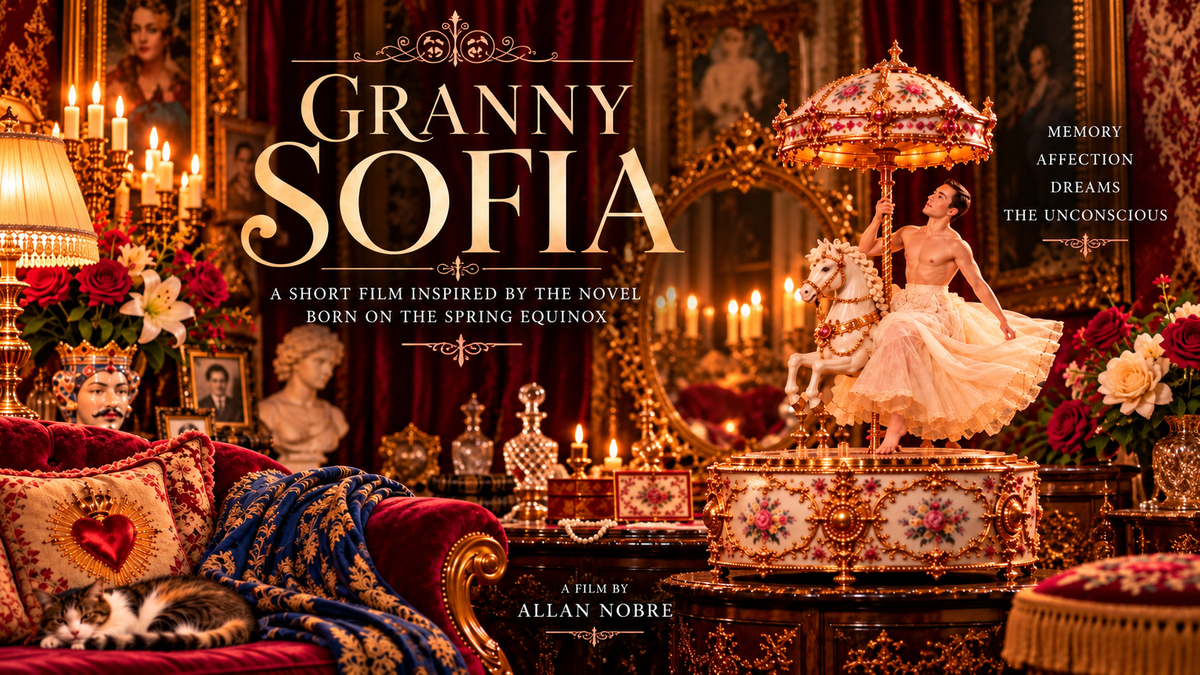
GRANNY SOPHIA
An original surrealist short film inspired by Born on the Spring Equinox, a novel by Allan Nobre.
Cinema & Short Films
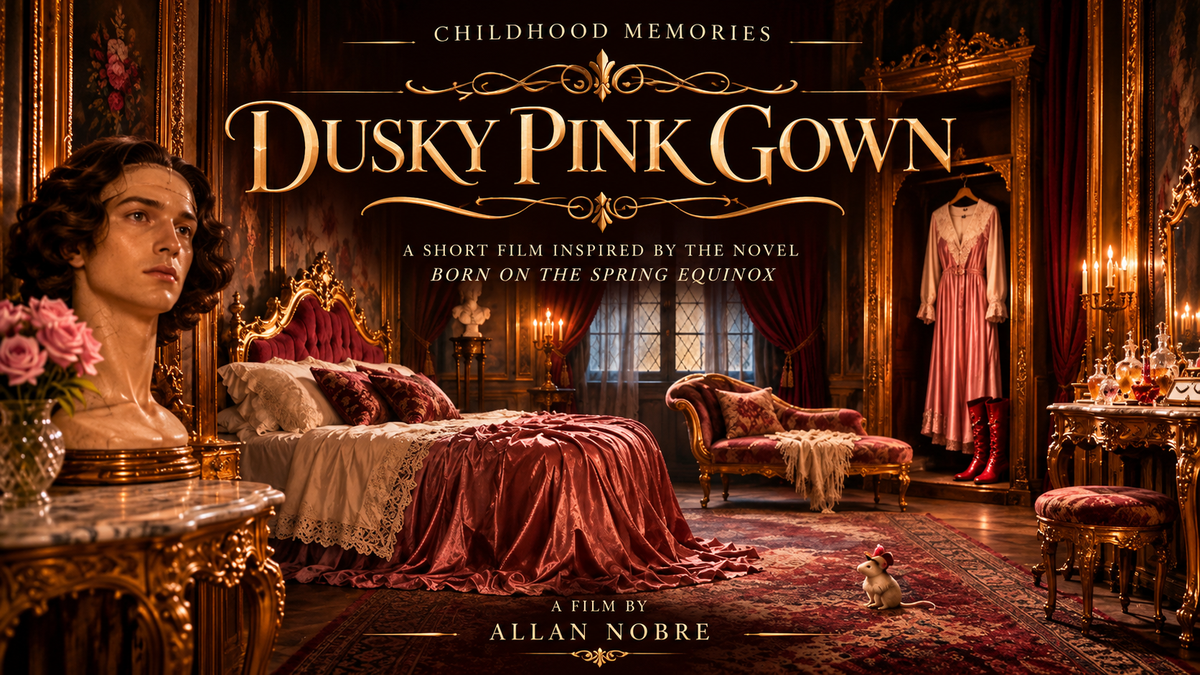
DUSKY PINK GOWN
A surrealist short film inspired by Born on the Spring Equinox, exploring childhood curiosity, identity and the unconscious through the mysterious beauty of a pink satin gown.
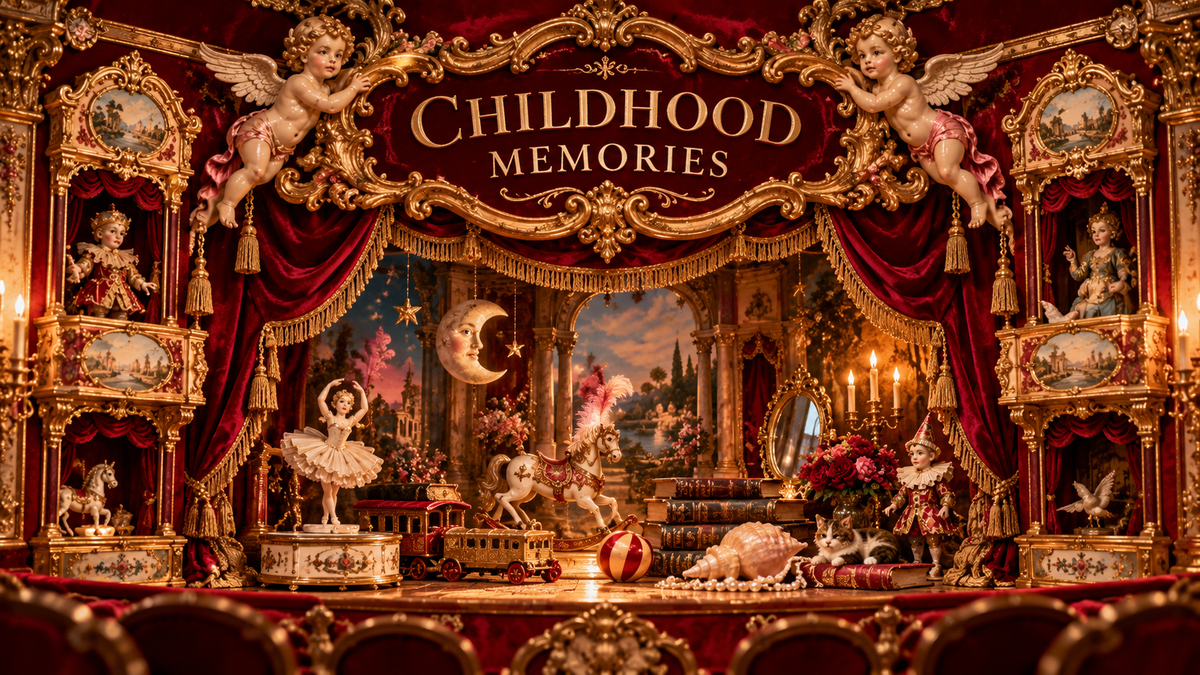
CHILDHOOD MEMORIES
A collection of surrealist short films inspired by Born on the Spring Equinox, exploring childhood, memory, imagination and the unconscious.